
03 Jul The Secret World of Addiction
Addiction
If you are into dark theatre, then definitely check out David Ireland’s bleak, hilarious play about two alcoholic men and their dysfunctional relationship with alcohol (and themselves). As a therapist working in the area of addiction, I wondered how Ireland, who is best known for his provocative, darkly comic and often politically charged outlook would tackle alcoholism: I was not disappointed – do go and see it if you get the chance. That aside, Ireland’s play tackles an area of addiction that never seems to be thought about, the area of secrecy in an addict’s behaviour. It’s set in the world on AA meetings – for those of you that are not aware, the AA 12 Step Programme is foundational recovery process of Alcoholics Anonymous a mutual aid fellowship founded in 1935 to help people recover from alcohol addiction. The 12 Steps are a set of spiritual and behavioural principles that guide individuals toward recovery. Ireland’s play centres on The Fifth Step, where addicts admit our wrongs to another, enabling them to confront their shame, anger, rage, hurt and deep feelings of abandonment – the cause perhaps of our addiction. By admitting to another your wrongdoings, you can move towards your own acceptance, and foster a deeper connection with both yourself and others.
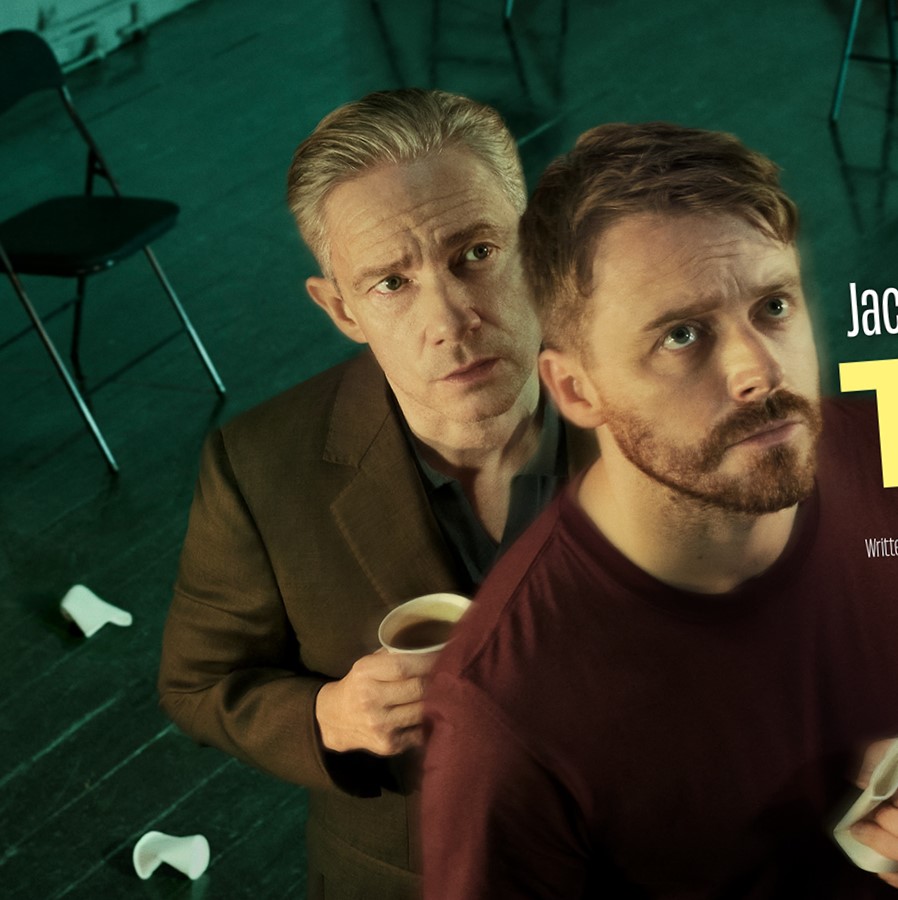
In David Ireland’s play, James (played by actor Martin Freeman) takes on the role of sponsor to a dishevelled, chaotic Luka (played by Jack Lowden) who is on the verge of Step Five in the programme, but whose progress is threatened by secrets that could plunge him back into an alcoholic mess. James too, has skeletons in his cupboard that threaten to derail his sobriety. There is a sense that addiction recovery is a fragile, precarious state where we constantly battle with past truths whose sole function seems to be to disrupt and derail our progress.
Back when I was a training therapist, I read a paper about this very subject, and Ireland’s play captures the nature of it so well. Written by Liz Good, this paper explores the secrete world of addicts, and how they often develop a “secret life”, which is dark and often hidden from the family (and the therapist) allowing them to be free to “act out”; perhaps sexually, it might be porn related, or perhaps other risky behaviour such as gambling or another drug (thus fulfilling an unconscious desire to control the object).
Psychoanalytically, addiction is thought to be a defence against overwhelming emotions, rage, shame, anger hurt and abandonment – it’s an attempt to, in some way, reverse some deep, painful narcissistic wound that feels unbearable. Addiction, weather it be alcohol, drugs, porn, gambling or prostitution, is a dysfunctional way to gain unconscious control over an object. Liz Good’s paper “many recovering addicts achieve high levels of recovery – develop areas of their lives that are productive and successful. However, there tends to be a psychic compromise – there becomes an area of their lives that they split off and keep hidden from people In their life – where they re-enact the need for mastery over the object” p152 (Narcissistic Wounds: Cooper and Maxwell 1995)
For those wishing to combat the complexly of their addiction, therapy does help so please do get in touch.
Nationwide organisations you can contact include:
No Comments